

Closing the Gap
Background
In February 2023, National Cabinet reaffirmed its commitment to Closing the Gap by renewing the National Agreement on Closing the Gap | Closing the Gap, originally signed in July 2020.
As part of this renewed commitment, governments agreed to shift the primary focus of implementation away from the socio-economic targets and towards the four Priority Reforms, recognising that structural and systemic change is necessary to achieve sustainable improvements in outcomes for Aboriginal and Torres Strait Islander peoples. The Priority Reforms are:
- Priority Reform One – Formal partnerships and shared decision-making: commits to building and strengthening structures for shared decision-making authority to accelerate policy and place-based progress against Closing the Gap.
- Priority Reform Two – Building the community-controlled sector: commits to strengthening Aboriginal and Torres Strait Islander community-controlled sectors to deliver services and support improved outcomes.
- Priority Reform Three – Transforming government organisations: commits to driving systemic and structural transformation of mainstream government organisations to improve cultural safety, accountability and responsiveness.
- Priority Reform Four – Shared access to data and information at a regional level: commits to enabling shared access to location-specific data and information (data sovereignty) to inform local-decision making and the achievement of the first three Priority Reforms.
The National Agreement on Closing the Gap is implemented in partnership with the Coalition of Peaks.
National oversight is provided by the Joint Council on Closing the Gap, which comprises Ministers from each jurisdiction and representatives of the Coalition of Peaks. The Joint Council is supported by the Partnership Working Group, consisting of senior government officials and Coalition of Peaks representatives.
In Queensland, peak bodies and state-wide Aboriginal and Torres Strait Islander-led services across health, child protection, legal services, family violence prevention, housing and media work collaboratively to support implementation of the National Agreement and progress the Priority Reforms (see below image).
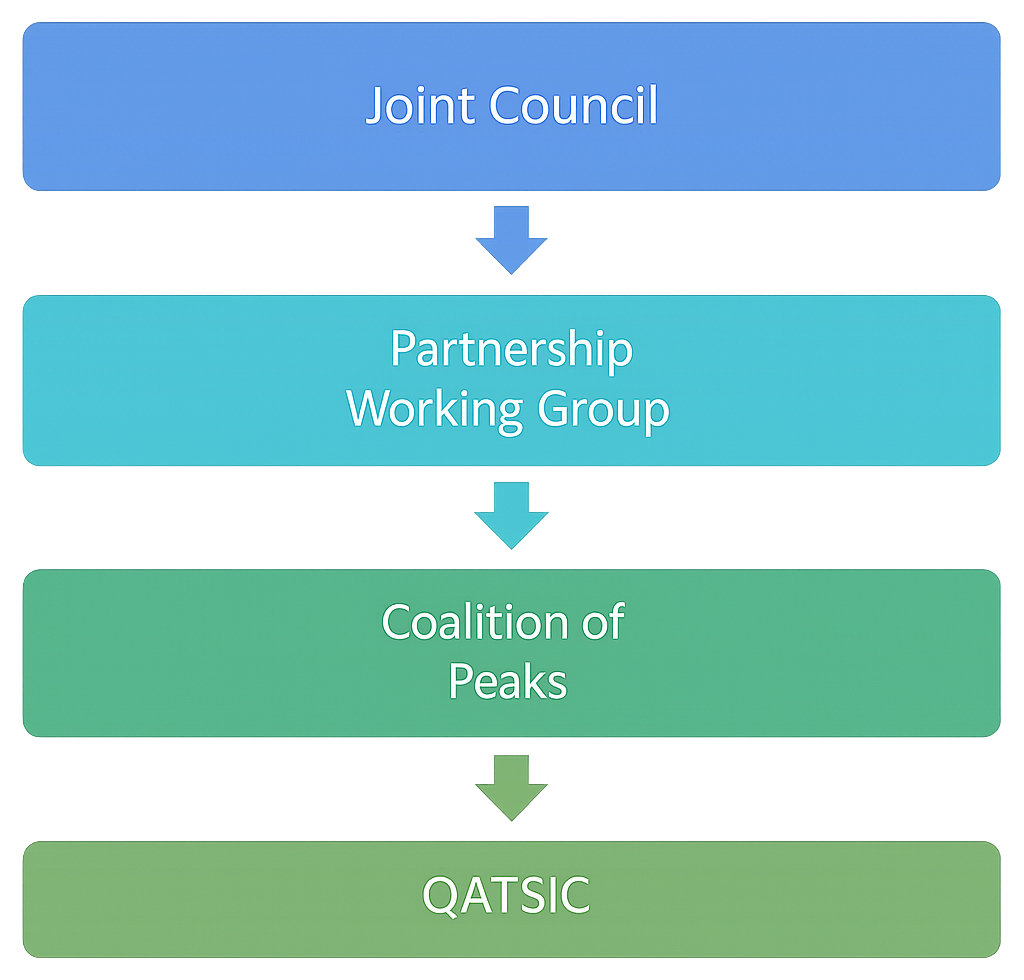
Governance structure for Closing the Gap, linking national oversight bodies with the Coalition of Peaks and state-based Aboriginal and Torres Strait Islander organisations.
QAIHC’s position
The Queensland Aboriginal and Islander Health Council supports the findings of the Productivity Commission’s 2024 review of Closing the Gap, which found progress against the Priority Reforms has been limited, fragmented, and largely incremental.
Current governance arrangements for Closing the Gap are not operating effectively and require significant reform. In Queensland, priorities continue to be predominantly government-driven and do not consistently reflect the priorities of Aboriginal and Torres Strait Islander communities or the sectors that represent them.
As the peak body for Aboriginal and Torres Strait Islander community controlled health organisations in Queensland, QAIHC is directly connected to communities through its Members. These organisations are trusted local authorities and are best placed to identify community priorities and deliver place-based, culturally appropriate solutions.
QAIHC advocates for a more targeted and strategic approach to Closing the Gap. Rather than spreading effort across all 17 socio-economic targets, greater impact could be achieved by prioritising a smaller number of key areas and delivering sustained, high-quality reform.
Place-based approaches are critical to success. Local and regional solutions, designed and led by communities, are more effective in addressing the complex and interrelated drivers of disadvantage.
QAIHC’s Model of Care is grounded in holistic, community-led service delivery that is culturally informed and focused on prevention. This approach emphasises social and emotional wellbeing and supports connection to cultural, spiritual, and community strengths. Strengthening the Aboriginal and Torres Strait Islander community controlled health organisation sector will deliver benefits across multiple policy areas, including health, education, employment, and justice.
Achieving the Closing the Gap targets by 2031 will require a renewed focus on implementing and measuring progress against the Priority Reforms. Despite the Agreement being in place since 2020, there remains a lack of robust, nationally consistent mechanisms to monitor progress and hold governments accountable.
QAIHC welcomes the opportunity to work in partnership with the Queensland Government to identify and implement practical, place-based reforms that will improve outcomes for Aboriginal and Torres Strait Islander Queenslanders.